Tile removal in Australia is priced per square metre, and published price guides put the rate somewhere between roughly $10 and $70 per square metre depending on what the tiles are, what they are stuck to and what condition the substrate has to be left in. On timing, most residential flooring removal jobs are completed within a day, with scope being the variable that changes that.
That price spread is wide enough to be nearly useless on its own, which is the honest problem with tile removal pricing. Two bathrooms of identical size in the same Gold Coast street can differ by a factor of three, and the reason is almost never the tiles. It is what is underneath them. This guide explains what actually moves the number, so you can read a quote properly and tell a thorough one from a cheap one.
Pricing noteThe figures in this guide are drawn from publicly published Australian tiling and flooring price guides, cited at the foot of this article. They are not Spotless Demolition quotes, and most published guides are national or Victorian rather than South East Queensland specific. Your actual cost depends on the tile type, substrate, adhesive bed, access and whether asbestos is present. Spotless Demolition provides free on-site inspections and quotes across Brisbane and the Gold Coast. Call 1300 128 970. |
Why is tile removal quoted per square metre?
Because the work is fundamentally repetitive. A crew lifts tiles, breaks out the bed underneath, prepares the surface and removes the waste, and the effort scales with area. Per square metre pricing lets a contractor quote consistently across jobs of different sizes.
What per square metre pricing hides is that the rate itself is not a constant. It is a function of the conditions on your particular floor, and a contractor who quotes a rate without inspecting the site is guessing. That guess usually resolves itself as a variation partway through the job, which is the least pleasant time to discover the real number.
What actually drives the cost of tile removal?
1. What the tiles are made of
Ceramic tiles are relatively soft and break predictably. Porcelain is denser, harder and slower to lift, and it fractures rather than shatters, which means more passes with the hammer. Natural stone is heavier again, and large-format tiles above roughly 600 by 600 millimetres are unwieldy, heavy to handle and prone to breaking in ways that damage the substrate underneath.
This is why published guides quote a lower band for standard ceramic and a distinctly higher one for large-format and natural stone. It is the same tool doing more work for longer.
2. What is underneath them, and how they were stuck down
This is the single biggest variable, and it is the one homeowners almost never think about.
- Thin-bed adhesive on a concrete slab. The best case. Tiles come up, adhesive residue gets ground back, the slab is ready.
- A full mud bed or sand-cement screed. Common in older Queensland bathrooms and laundries. The tiles sit on a thick cement bed that has to come out as well, and that is a different job entirely. It can double or triple the labour on a small wet area.
- Timber or particleboard subfloor. Removal has to be gentler because the substrate damages easily. Gouges, splits and residual adhesive all need repair before anything new goes down.
- Compressed fibre cement sheet in wet areas. Often has to be replaced rather than salvaged, which brings a carpentry component into what looked like a demolition job.
- Tiles laid over tiles. More common than you would expect. Both layers usually have to come out because the combined thickness affects finished floor heights at doorways and thresholds.
3. What condition the substrate has to be left in
There is a real difference between “tiles removed” and “surface ready to tile”. If your new floor is large-format tile, vinyl plank or a floating floor, the substrate has to be flat within tight tolerances, and that means grinding back adhesive residue and often applying a levelling compound. If you are relaying a similar tile with a forgiving adhesive, you may need less.
Ask any quote you receive to state explicitly which one it covers. A quote that ends at “tiles removed” and a quote that ends at “surface ground, levelled and ready for your floor layer” are not comparable, and the gap between them is real money.
4. Waterproofing in wet areas
Removing floor or wall tiles in a bathroom, ensuite or laundry will almost always breach the waterproofing membrane beneath them, because the membrane sits directly under the tile bed. Once breached, it has to be reinstated before new tiles are laid.
Waterproofing of domestic wet areas in Australia is governed by AS 3740, which is referenced by the National Construction Code, and in Queensland waterproofing is licensed work under the QBCC framework. This is a separate trade and a separate cost from the tile removal itself, so it should appear as its own line in your renovation budget rather than being assumed into the demolition quote.
5. Access and site conditions
A ground floor slab with a driveway ten metres away is the cheapest possible scenario. A third-floor apartment in Surfers Paradise with lift booking windows, a loading dock, body corporate rules and a long carry to the vehicle is not the same job, even if the floor area is identical. Tiles are heavy, and every metre of carry distance multiplied by the tonnage adds up.
- Ground floor with direct vehicle access is the baseline.
- Stairs, lifts and long carries add labour time.
- High-rise buildings on the Gold Coast often restrict work hours, lift access and waste routes.
- Occupied homes need more containment and protection than empty ones.
6. Dust control and silica compliance
This is the cost driver that has changed most in recent years, and it is worth understanding properly because it separates compliant contractors from cheap ones. It gets its own section below.
7. Waste volume and weight
Tiles and mortar bed are dense. A modest bathroom can produce a surprising tonnage, and tip fees for heavy inert material are charged by weight rather than by volume. Whether the quote includes removal and disposal, or leaves a pile of rubble on your driveway for you to deal with, is one of the most important questions to ask.
What do published price guides actually say?
Here is what Australian tiling and flooring guides published in 2025 and 2026 state for tile removal. We have listed them separately rather than averaging them, because the variation between sources is itself the useful information.
| Published guide | Stated tile removal rate | Scope as stated |
|---|---|---|
| LocalTasker (Melbourne) | $10 to $20 per m2 | Removal of existing flooring |
| A Timber Floorer (Australia guide) | $15 to $30 per m2 | Tile removal and disposal, plus skip hire if volume is significant |
| TradieVerify (Australia guide) | $25 to $50 per m2 | Old tiles chipped off and carted away in a bathroom retile |
| The Quote Yard (Victoria, 2026) | $25 to $45 per m2 | Standard ceramic on solid substrate |
| The Quote Yard (Victoria, 2026) | $40 to $70 per m2 | Large-format or thickly adhered natural stone |
| FloorVenue (Australia) | $40 to $60 per m2 | Ceramic and porcelain, removal and disposal, before substrate prep |
| FloorVenue (Australia) | $10 to $40 per m2 | Vinyl tiles, which often leave adhesive residue |
Three things to take from that table. First, the honest range is wide. Second, the higher figures generally correspond to jobs that include disposal and harder materials, and the lower ones often do not include disposal at all. Third, none of these guides are South East Queensland specific, and most are written from a Melbourne or generic national perspective. Treat them as a sanity check on a quote, not as a quote.
The red flag testIf a quote comes in well below the published range and does not mention the substrate, disposal or dust control, those things have not been priced. They have not stopped existing. They will appear later as variations, or they will simply not be done, and you will find out when your floor layer refuses to work on the surface you have been left with. |
How long does tile removal take?
Spotless Demolition completes most flooring removal jobs within a day, depending on the scope of the project. For a straightforward residential floor with good access, a single day covering removal, dust management and site clearance is a realistic expectation.
What extends it is almost always one of a short list of conditions.
| What makes it longer | Effect on the schedule |
|---|---|
| A full mud bed or sand-cement screed under the tiles | Adds substantial break-out time. The bed is often thicker and harder than the tiles above it. |
| Levelling compound required after removal | Adds curing time before the next trade can start, which is calendar time rather than labour time. |
| Multiple rooms or a whole ground floor | Scales roughly with area, though setup and containment are shared across the job. |
| Wall tiles as well as floor tiles | Wall removal is slower per square metre and adds substrate repair work. |
| Difficult access, high-rise or restricted work hours | Can stretch a one-day job across two or more site visits. |
| Suspected asbestos | Stops the job until material is assessed. Confirmed asbestos becomes a separate licensed removal stage before tiling work resumes. |
If you are coordinating trades, the number that matters is not the demolition day. It is the date the surface is ready for your floor layer or waterproofer. Ask for that date specifically, and ask whether it includes any curing time for levelling compound.
Why does silica compliance affect the price?
Since 1 September 2024, Queensland has had stronger regulation on the processing of crystalline silica substances, brought into the Work Health and Safety Regulation 2011 (Qld). A crystalline silica substance is defined as any material containing at least one per cent crystalline silica by weight, and Workplace Health and Safety Queensland lists tiles explicitly among the common materials that qualify, alongside bricks, blocks, pavers, mortar, concrete and cement-based products such as fibre cement sheeting.
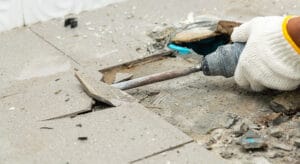
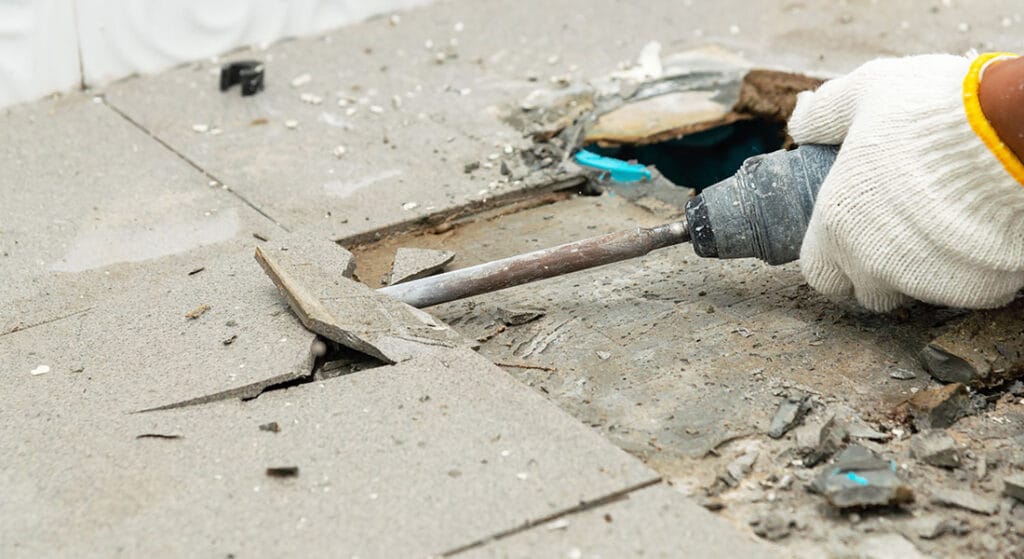
Processing a crystalline silica substance includes using power tools or mechanical plant to crush, cut, grind, trim, sand, abrasive polish or drill it. Removing tiles with a demolition hammer and grinding the adhesive bed back off a slab sits squarely inside that definition.
Under the regulation, a business must assess before work starts whether the processing is high risk, and that assessment must be recorded in writing. Where it is high risk, the business must provide instruction, information and training to workers about the health risks of respirable crystalline silica and the controls that apply, and must prepare a silica risk control plan before processing starts, or a safe work method statement where the work is construction work. Businesses also have to consider whether air monitoring and health monitoring are required under existing parts of the regulation. If a business cannot make a determination either way, the processing is treated as high risk until a determination to the contrary is made.
None of that is free. Training, documented assessments, control plans, dust extraction equipment and respiratory protection all carry cost, and they are part of what a compliant contractor is pricing into a per square metre rate. A quote that undercuts the market substantially is often a quote that has priced none of it.
Why this matters beyond complianceRespirable crystalline silica dust causes silicosis, which is irreversible. The regulation exists because of what the dust does to the people working in it, and because it does not stay in the room where it is generated. Dust extraction on a tile removal job in an occupied home protects the household as much as the crew. |
This is also the practical argument for dustless tile removal rather than open demolition. Spotless Demolition uses concrete grinders, demolition hammers and dust extractors together, with protective sheeting over furniture and a clean-down afterwards, and applies a systematic dust management approach on internal demolition jobs.
What about asbestos?
For any Brisbane or Gold Coast home built before 1990, asbestos-containing materials have to be considered before a floor is disturbed. The relevant materials in a flooring context are not always obvious.
- Vinyl floor tiles, particularly the older 9 inch and 12 inch square tiles.
- The backing sheet or underlay beneath sheet vinyl.
- Black bitumen-based adhesive used to bond older floor coverings.
- Fibre cement sheeting used as a substrate or wall lining in wet areas.
Disturbing asbestos-containing material without proper containment and licensed removal is illegal in Queensland and a serious health risk. If there is any doubt about the age of the flooring or what sits beneath it, the material should be assessed before work starts rather than after. Spotless Demolition’s asbestos removal service covers assessment, safe removal, containment and legal disposal as one service, so a suspected material does not have to become a separate procurement exercise mid-renovation.
What questions should you ask before accepting a quote?
- Is the quote based on an on-site inspection or a phone call? A rate quoted without seeing the substrate is a guess.
- Does it include removal and disposal of the waste, or just the demolition? Tiles are heavy and disposal is charged by weight.
- Does it include grinding back the adhesive and preparing the surface? State what the next floor covering will be, because the required tolerance depends on it.
- Is levelling compound included or excluded? This is a common exclusion and a common variation.
- What dust control is used, and is there a documented silica risk assessment? Both a compliance question and a liveability one.
- What happens if asbestos is found? You want to know the process and who holds the licence before the job starts, not on the day.
- What condition will the site be left in? Swept, vacuumed and ready for the next trade should be the standard.
- Who is responsible if the substrate is damaged? Ask about insurance cover, and confirm it in writing.
Frequently asked questions
How much does tile removal cost in Brisbane and the Gold Coast?
Published Australian price guides put tile removal between roughly $10 and $70 per square metre, with the higher end applying to large-format tiles, natural stone and jobs that include disposal. Those guides are national or Victorian rather than Queensland specific, so use them as a sanity check rather than a quote. The accurate number for your floor comes from an on-site inspection that looks at the substrate and adhesive bed, which Spotless Demolition provides free across Brisbane and the Gold Coast.
How long does it take to remove tiles from a bathroom?
Most residential flooring removal jobs are completed within a day, depending on scope. A small bathroom floor on a concrete slab with thin-bed adhesive sits at the quick end. A bathroom with a full mud bed, wall tiles as well as floor tiles, or restricted access will take longer, and levelling compound afterwards adds curing time before the next trade can start.
Can I remove floor tiles myself?
Physically, sometimes. Practically, it is one of the tasks where DIY most often costs more than it saves. The three usual outcomes are a substrate damaged badly enough to need professional repair, dust through the entire house because a domestic vacuum is not an extraction system, and a load of heavy rubble with nowhere to go. In a pre-1990 home there is also the risk of disturbing asbestos-containing material, which turns a weekend job into a remediation.
Do I have to move out while tiles are being removed?
For most tile removal jobs, no. Containment, extraction and protective sheeting are designed to keep the work zone separate from the rest of the home. If asbestos removal is required, temporary vacation of the affected area is needed for that specific phase, and your project consultant will advise at the quoting stage.
What happens to all the removed tiles?
Tiles, mortar and rubble are inert construction waste. Spotless Demolition removes the material as part of the job and sorts it for recycling where the material type allows, with the balance disposed of in compliance with Queensland waste regulations. Nothing is left on your driveway for you to arrange separately.
Does removing tiles mean I need to redo the waterproofing?
In a wet area, almost always yes. The waterproofing membrane sits under the tile bed, so removing the tiles breaches it. It has to be reinstated to AS 3740 before new tiles go down, and in Queensland that is licensed work. Budget it as its own line item.
Get an accurate tile removal quote
Spotless Demolition & Rubbish Removal has been removing tiles, stone, timber, vinyl and other flooring from Brisbane and Gold Coast properties for over three decades, using concrete grinders, demolition hammers and dust extractors for dustless removal. Free on-site inspection, no obligation, and the waste goes with us.
Call 1300 128 970 or request a free quote online.