Every renovation starts with a plan and usually with a budget that feels optimistic. The idea of picking up a sledgehammer and knocking out a wall yourself is appealing: it looks straightforward, it feels satisfying, and it saves money. In some very limited circumstances in Queensland, a homeowner can legally carry out minor demolition work on their own property. In many more circumstances, they cannot, and attempting it carries real legal, financial, and physical risks.
This is the honest guide to where the line actually sits. Spotless Demolition provides professional demolition services on the Gold Coast and in Brisbane, and we have seen the consequences of DIY demolition gone wrong more than enough times to want every homeowner to understand the rules before they start.
Not Sure Whether Your Job Needs a Pro?Spotless Demolition offers free inspections and quotes across the Gold Coast and Brisbane. Call 1300 128 970. |
The Regulatory Framework: Who Makes the Rules?
Before getting into what is and is not allowed, it helps to understand which regulatory frameworks govern demolition work in Queensland. There are several, and they often apply simultaneously.
- Queensland Building and Construction Commission (QBCC): the QBCC is the primary licensing authority for building work in Queensland. Demolition falls within the scope of building work under the Queensland Building and Construction Commission Act 1991. Performing licensable demolition work without a QBCC licence is an offence
- Building Act 1975 (QLD): the Building Act governs the approval of building work in Queensland, including demolition. A building approval (development permit) is required for most demolition beyond minor works
- Planning Act 2016 (QLD): development that includes demolition may also require a development approval under this Act, particularly where heritage listings, overlays, or specific planning zones are relevant
- Work Health and Safety Act 2011 (QLD): all demolition work, whether performed by licensed professionals or property owners carrying out their own work, must be done safely. This Act imposes a duty of care on persons conducting a business or undertaking (PCBU) and on workers, which in a domestic context can apply to homeowners who direct or engage in demolition work on their own property
- Environmental Protection Act 1994 (QLD): waste management, dust, and noise from demolition work are regulated under this Act. Illegal disposal of demolition waste, including asbestos, carries significant penalties
What Homeowners Can Generally Do Themselves in QLD
The scope for homeowner DIY demolition in Queensland is narrower than many people assume. The following categories of minor work are generally not licensable or approval-dependent, but this is not a comprehensive list and specific circumstances can change the picture:
- Removing surface finishes and coverings: taking up floor coverings such as carpet, vinyl, or laminate, and removing wall linings such as wall panels or decorative coverings, is generally within a homeowner’s scope where the work does not affect structural elements, plumbing, electrical, or gas services, and does not involve asbestos-containing materials
- Removing non-structural joinery and fixtures: removing kitchen cupboards, built-in wardrobes, shelving, doors, and similar non-structural joinery is generally something a property owner can do, subject to the same caveats about services and asbestos
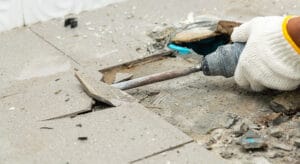
- Tiles in limited contexts: removing floor and wall tiles in a setting where there is no risk of disturbing asbestos-containing tiles or adhesive, and where removal does not affect structural elements. Pre-1990 tiles and adhesives may contain asbestos
- Minor garden structures: demolishing small garden sheds, simple pergolas, or similar minor non-habitable structures in some circumstances, subject to local council requirements and the absence of any services connections
The recurring conditions that apply across all of these: no asbestos-containing materials, no structural elements, no impact on electrical, plumbing, or gas services, and compliance with waste disposal requirements.
| ⚠️ Pre-1990 building materials and asbestos: Any building constructed or renovated before 1990 should be treated as potentially containing asbestos until confirmed otherwise. Asbestos was used in a wide range of building materials including cement sheeting, roofing, floor tiles, adhesives, pipe lagging, and ceiling tiles. Before removing any material in a pre-1990 building, have an assessment conducted by a qualified professional. The consequences of disturbing asbestos unintentionally are serious for you and for anyone else in or near the property. |
What Requires a Licensed Contractor in QLD
The following types of demolition work in Queensland require a QBCC-licensed contractor and, in most cases, a building approval or development permit:
Structural and load-bearing elements
Any demolition that affects a load-bearing or structural element of a building, including internal load-bearing walls, beams, columns, floor structures, and roof structures, requires a licensed building contractor. In Queensland, removing an internal wall is only legal as DIY work if the wall is definitively and verifiably non-load-bearing. Determining whether a wall is load-bearing requires structural assessment: it cannot be reliably determined by visual inspection alone. Many walls that do not appear structural do carry loads, particularly in older construction where original structural calculations may not be available.
Asbestos removal
The removal of asbestos-containing materials is strictly regulated under Queensland’s Work Health and Safety Regulation 2011. There are two key categories:
- Class A licensed removalist: required for the removal of any friable asbestos (asbestos that can be crumbled, pulverised, or reduced to a powder by hand pressure), and for any asbestos removal from facilities subject to specific regulatory requirements. There is no threshold below which friable asbestos can be removed without a Class A licence
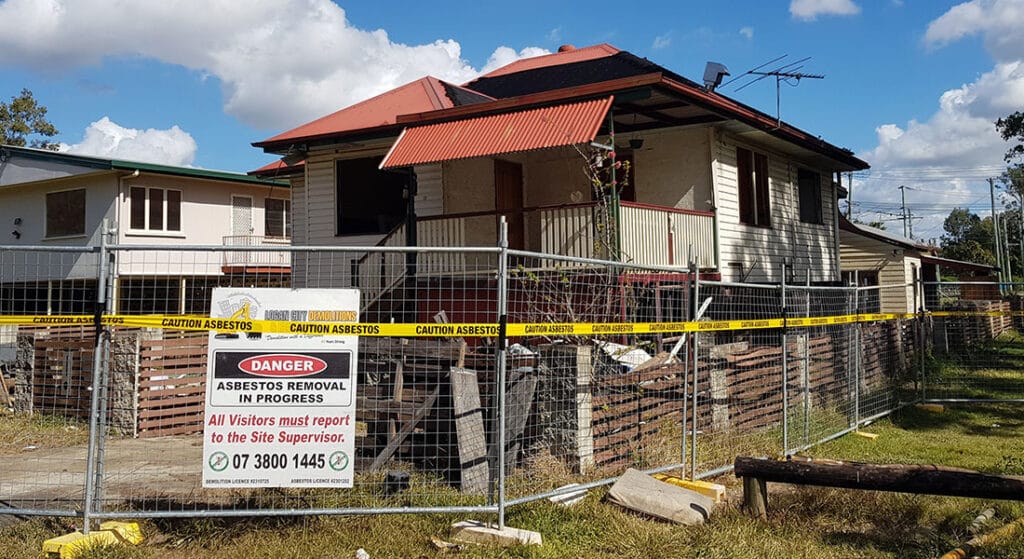
- Class B licensed removalist: generally required for the removal of non-friable (bonded) asbestos-containing materials greater than 10 square metres in area. Below this threshold, some removal may be permitted for homeowners working on their own property, but Queensland’s Work Health and Safety Regulator and the Queensland Government strongly recommend engaging a licensed professional regardless of the area, because correctly identifying bonded asbestos, preparing a safe work method statement, and disposing of the material safely requires specialist knowledge and equipment
Spotless Demolition provides professional asbestos removal on the Gold Coast and in Brisbane. Do not attempt to remove suspected asbestos-containing materials without professional assessment.
Full building demolition
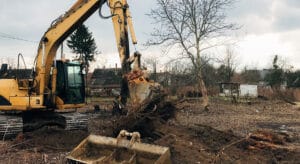
The complete demolition of a residential or commercial building is a licensed contractor activity. It requires QBCC licensing, typically a development approval from the relevant local council, and compliance with the Building Act 1975 requirements for demolition approval. Before demolition can proceed, an asbestos survey is typically required for any building that may contain asbestos-containing materials.
Any work involving licensed trades
Even if the demolition itself were within a homeowner’s scope, any work that incidentally affects electrical wiring, plumbing, or gas services during the demolition process requires those elements to be disconnected, made safe, or reconnected by the appropriate licensed tradesperson. Demolishing a wall without properly isolating electrical wiring, capping pipes, or isolating gas lines is illegal and dangerous.
The Hidden Risks of DIY Demolition
The practical risks of DIY demolition in Queensland go beyond the legal framework:
- Structural instability: removing a wall or element that turns out to be structural can cause immediate and catastrophic structural failure. The consequences range from ceiling collapse to total structural compromise of the building
- Asbestos exposure: disturbing asbestos-containing materials releases asbestos fibres that are invisible, odourless, and permanently damaging to lung tissue. There is no safe level of asbestos fibre exposure, and the effects of asbestos-related disease may not become apparent for decades after exposure
- Electrical and fire risk: cutting through walls without knowing the location of electrical wiring is a direct electrocution and fire risk
- Plumbing and water damage: cutting into walls containing water pipes without isolating the water supply creates an immediate flood risk and potential for significant property damage
- Dust exposure: demolition generates significant airborne dust including silica dust, which causes silicosis (a serious and irreversible lung disease). Professional demolition teams use appropriate dust management and respiratory protection. Spotless Demolition provides specialist dust management as part of every project
- Waste disposal liability: demolition waste, particularly materials containing hazardous substances, cannot be disposed of in general waste streams. Illegal disposal of demolition waste is a serious offence under Queensland’s Environmental Protection Act 1994. Professional rubble and renovation waste removal ensures waste is handled and disposed of lawfully
An Honest Summary: What This Means for Your Project
| Task | DIY in QLD? | Professional required? |
|---|---|---|
| Removing carpet or vinyl flooring | Generally yes, with no asbestos risk | No (unless asbestos adhesive suspected in pre-1990 buildings) |
| Removing kitchen cabinets and non-structural joinery | Generally yes, no services affected | No for the joinery; yes if plumbing or electrical is involved |
| Removing floor or wall tiles (post-1990) | Generally yes | No (confirm no asbestos risk) |
| Removing floor or wall tiles (pre-1990) | No without professional assessment | Yes: asbestos risk must be assessed first |
| Removing an internal wall | Only if confirmed non-load-bearing by a structural assessment | Yes for load-bearing walls; yes for structural assessment |
| Asbestos removal (any type) | No (Class A or B licence required for most circumstances) | Yes |
| Full house or building demolition | No | Yes (QBCC licence and development permit required) |
| Any work near electrical, plumbing, or gas | No | Yes (licensed tradesperson required for service work) |
If you are unsure whether your project requires a licensed professional, the safest approach is to ask. Spotless Demolition offers free site inspections across the Gold Coast and Brisbane to assess your project and advise on the scope, required approvals, and the safest approach.
Talk to Spotless Demolition Before You StartFree inspections and quotes. Gold Coast and Brisbane. Family owned. Safe, professional, eco-friendly demolition services. |
Frequently Asked Questions
Can I demolish a wall in my own home in QLD without a licence?
Only if the wall is definitively confirmed as non-load-bearing by a structural assessment, and if the demolition does not affect any electrical, plumbing, or gas services within or adjacent to the wall, and if the wall is confirmed free of asbestos-containing materials. In practice, all three conditions need to be verified before proceeding. Spotless Demolition’s internal wall removal service provides licensed, compliant wall removal across the Gold Coast and Brisbane.
Is asbestos removal dangerous for homeowners to do themselves?
Yes. Any level of asbestos fibre exposure is considered hazardous, and removal of asbestos-containing materials by unlicensed persons creates significant personal health risk and potential liability. Even for non-friable asbestos removal below the 10 square metre threshold where some homeowner removal may technically be permitted, the Queensland Government recommends using a licensed asbestos removalist because safe identification, preparation, removal, and disposal requires specialist training and equipment. Spotless Demolition provides licensed asbestos removal safely and legally.
What are the consequences of doing unlicensed demolition work in QLD?
Performing licensable demolition work without a QBCC licence is an offence under the Queensland Building and Construction Commission Act 1991 and can attract significant penalties. Additionally, unlicensed work may invalidate your home insurance, create liability for injury or damage to others, and create complications when you sell the property, as unpermitted work can be flagged during property searches. The Queensland Building and Construction Commission (qbcc.qld.gov.au) is the authoritative source for current penalty information and licensing requirements.