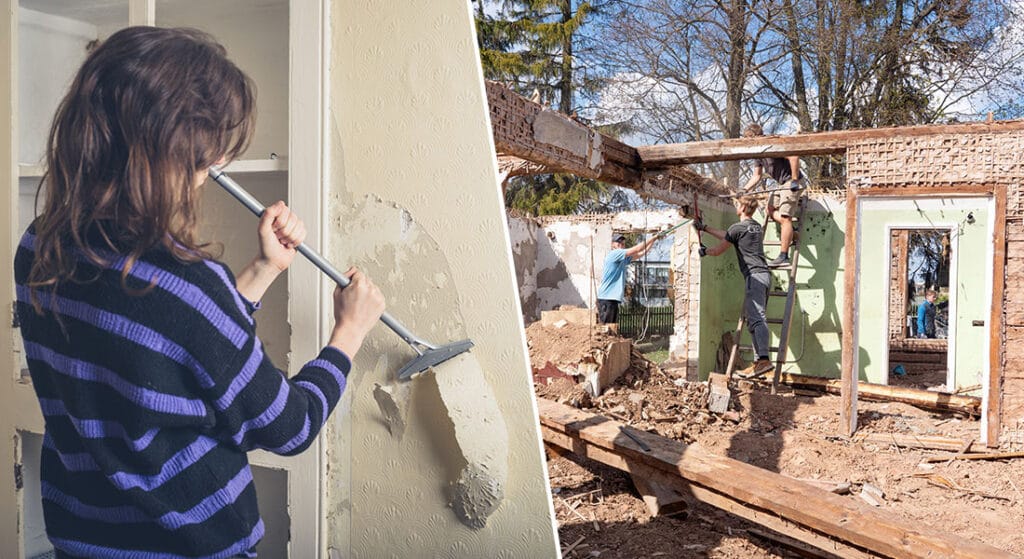
When a renovation is coming up, a lot of homeowners look at the strip-out phase and think: how hard can it be? Knock out the old bathroom tiles, pull off the kitchen cabinets, rip up the flooring. Get stuck in on a weekend, save some money, and be ready for the builder on Monday.
Sometimes it works out that way. Often it doesn’t. The strip-out phase of a renovation is where costs blow out, timelines slip, and safety incidents happen — and the decision between doing it yourself or bringing in a professional demolition company is one that deserves a clear-eyed look before you pick up a sledgehammer.
This article gives you the honest comparison: what DIY strip-outs actually involve, where the hidden costs sit, where the real risks are, and what a professional team brings to the job.
| 🏗️ Want the Job Done Right the First Time? Spotless Demolition offers free residential quotes across the Gold Coast and Brisbane. Family-owned, 30+ years experience, insured to $20M. |
What Does a Residential Strip-Out Actually Involve?
A strip-out — also called a demolition or a knock-down of non-structural elements — typically covers the removal of:
- Tiles (floor and wall), adhesive and screed
- Kitchen and bathroom cabinets, benchtops, and appliances
- Vanities, baths, showers, and toilets
- Plasterboard lining, cornices, and architraves
- Flooring — vinyl, carpet, hardwood, laminate
- Internal walls (non-structural — structural walls require engineering assessment)
On paper, it’s removal work. In practice, it generates large volumes of debris, significant dust, and requires knowledge of what’s inside walls and under floors before you can safely proceed.
The Case for DIY: Where It Makes Sense
Let’s be fair — there are scenarios where a homeowner doing some or all of their own strip-out work is a reasonable choice.
- Simple, small-scope tasks — removing a few kitchen cabinet doors, pulling up carpet in a single room, or taking out a vanity in a small bathroom — are within most capable DIYers’ skills.
- If you have genuine trade experience — you’re a builder, a tiler, or have done this type of work professionally — your risk profile is very different from a complete first-timer.
- Budget is genuinely constrained and the scope is limited, well-understood, and carries no known hazard risks.
The key qualification: DIY only makes practical sense when the scope is simple, the materials are confirmed free of hazards like asbestos, and you have the time and physical capacity to see it through properly.
The Hidden Costs of DIY Demolition
This is where most DIY strip-outs come unstuck. The upfront cost comparison — professional quote vs zero labour — looks compelling. The actual cost comparison after the job is rarely as clean.
Equipment hire
A professional strip-out requires more than a hammer and a crowbar. Depending on the job, you may need to hire: angle grinders, rotary hammers, tile chisels, an industrial dust extractor, a skip bin, a trailer or truck for multiple loads, and safety PPE including respirators, goggles, and gloves. Equipment hire costs add up quickly, often reaching several hundred dollars per day for a full-sized job.
Waste removal
Renovation waste is heavy, bulky, and can’t go in a regular council bin. Tiles, screed, plasterboard, and timber all need to be transported and disposed of through licensed channels. A skip bin for a bathroom strip-out can cost $300–$600 alone. Professional demolition teams handle all of this as part of the service — our rubble and renovation waste removal is included in every job, with eco-friendly disposal as standard.
Time — the cost nobody budgets for
A professional team completes a standard bathroom strip-out in a matter of hours. A homeowner doing the same job, without the right tools or technique, frequently takes a full weekend — and sometimes two. Every day the renovation is delayed while you’re still in the strip-out phase has a downstream cost: the builder can’t start, tradespeople are rescheduled, accommodation costs extend if you’ve vacated the property.
Damage to surrounding areas
One of the most consistent differences between professional and DIY strip-outs is the condition of the surrounding surfaces afterwards. Professionals use protective drop sheets, targeted cutting techniques, and dust control measures to isolate the demolition area. DIY strip-outs regularly result in scratched floor surfaces, cracked tiles in adjacent areas, and dust penetrating through the entire property — creating additional remediation cost before the build can begin.
| ✅ Pro Tip: Spotless Demolition uses advanced dust extractors and protective drop sheets on every job. We leave the site cleaner than we found it — not dirtier. |
The Real Risks of DIY Strip-Outs
Cost overruns are frustrating. Safety incidents are far more serious. Here are the risks that the DIY strip-out conversation doesn’t always address clearly enough.
Asbestos
In South East Queensland, any building constructed before 2003 may contain asbestos-containing materials. Fibro cladding, vinyl floor tiles, textured ceiling coatings, and pipe lagging can all contain asbestos. Disturbing these materials without proper controls — cutting, grinding, or breaking them — releases fibres that cause serious and often fatal disease. Under Queensland law, asbestos removal above trace quantities must be carried out by a licensed removalist. There are no exceptions. Our licensed asbestos removal service ensures this is handled safely and legally.
| ⚠️ DIY Asbestos Disturbance Is Illegal Homeowners who unknowingly disturb asbestos during DIY work can face serious health consequences and potential legal liability. If your home was built before 2003, get a professional asbestos inspection before any strip-out begins. Spotless Demolition can assess and manage this as part of your job.
|
Structural walls
Identifying whether a wall is load-bearing requires professional assessment — it cannot be reliably determined by a homeowner based on wall orientation alone. Removing a load-bearing wall without proper support causes structural damage that can range from cracking and sagging to catastrophic collapse. Our internal wall removal service includes a pre-job structural assessment as standard.
Electrical and gas lines inside walls
Cutting or hammering into a wall that contains live wiring creates an immediate electrocution risk. Hitting a gas line creates an immediate fire and explosion risk. Without professional detection equipment and knowledge of how services are routed, DIY wall demolition carries real danger for the person doing the work and others in the building.
Physical injury
Strip-out work is physically demanding and involves sharp materials, heavy debris, and awkward working positions. Without professional technique, the risk of cuts, strains, and dropped materials causing injury is higher than most people anticipate before they start.
DIY vs Professional: The Full Comparison
| Factor | DIY Strip-Out | Professional Demolition |
| Labour cost | Zero (your time) | Quoted upfront, no hidden costs |
| Equipment | Hire cost: $200–$600+ per day | Included in quote |
| Waste removal | Skip hire + multiple trips: $300–$800 | Included, eco-friendly disposal |
| Time (bathroom) | 1–2 full weekends | Half to one day |
| Asbestos management | Illegal if present — serious risk | Licensed removal included |
| Structural assessment | Not included — significant risk | Completed before work begins |
| Dust control | Typically poor — whole house affected | Industrial extractors, drop sheets |
| Damage to surrounding areas | Common without professional technique | Minimal — careful protection |
| Insurance coverage | Homeowner’s insurance (may not cover) | Fully insured to $20 million |
| Project timeline risk | High — delays are common | Low — professional scheduling |
When Professional Demolition Costs Less Than DIY
This sounds counterintuitive — but it’s a calculation worth running. When you add together equipment hire, waste disposal, the time cost of two weekends of hard labour, and the potential cost of damage to surrounding areas or a project delay, professional demolition for a standard bathroom or kitchen strip-out often comes in at a similar or lower total cost to DIY — and with none of the risk.
For jobs involving any asbestos risk, any structural walls, or any scope beyond a small, single-room task, the case for professional demolition is clear. The liability exposure alone from an asbestos or structural incident far exceeds the cost of a professional quote.
| ✅ Pro Tip: Spotless Demolition offers free quotes with no obligation — so you can see the actual cost before you commit. Most clients are surprised how competitive professional pricing is once they factor in the true cost of DIY. |
What to Look for in a Professional Demolition Company
Not all demolition companies are equal. Before engaging anyone for a strip-out, check:
- Are they licensed for asbestos removal? (Required in Queensland for anything above trace quantities)
- Are they fully insured? (Public liability to at least $20 million is the standard for professional operators)
- Do they offer a written quote before starting work?
- Do they handle waste removal and disposal as part of the service?
- Do they have documented experience with jobs of similar scope?
- Are they clear about what’s included — and what isn’t?
Spotless Demolition is fully licensed, insured to $20 million, and has been operating on the Gold Coast and Brisbane for over 30 years. Founded by Joseph Principato — a veteran of both demolition and bathroom renovation — the business was built specifically to address the gap between what clients needed and what the industry was delivering. Read our full story and see what sets us apart.
| 🏗️ Get a Free Residential Demolition Quote No obligation. No surprises. Spotless Demolition serves the Gold Coast and Brisbane — and we leave every site cleaner than we found it. |
Frequently Asked Questions
Can I legally do my own demolition in Queensland?
For non-structural work that doesn’t involve asbestos, homeowners can carry out some demolition themselves. However, any work involving asbestos-containing materials must be handled by a licensed asbestos removalist. Structural wall removal requires council approval in some cases and always requires a structural assessment. Contact the Queensland Building and Construction Commission (QBCC) if you’re unsure about your specific situation.
How much does professional residential demolition cost on the Gold Coast?
Costs vary based on the scope and size of the project. A bathroom strip-out is typically more affordable than most homeowners expect — particularly when waste removal, equipment, and dust management are factored in. Spotless Demolition offers free quotes so you know the full cost upfront with no hidden surprises.
How long does a professional bathroom or kitchen strip-out take?
For a standard single bathroom or kitchen, Spotless Demolition typically completes the strip-out in half a day to one full day. Larger or more complex jobs take longer. We’ll give you a clear timeline as part of your quote.
What happens to the waste from a strip-out?
Spotless Demolition handles all waste removal and disposal as part of every job. We use eco-friendly disposal methods, separating materials for recycling wherever possible. Our rubble and renovation waste removal service means nothing is left for you to deal with.
Does Spotless Demolition handle asbestos if it’s found?
Yes. Spotless Demolition holds the required licensing for asbestos removal in Queensland and follows the Work Health and Safety Act 2011 and the National Code of Practice for asbestos management. See our asbestos removal page for full details.
Do I need council approval for a residential strip-out?
For internal strip-outs — removing tiles, kitchen, bathroom fittings, and non-structural elements — council approval is typically not required. For structural changes including wall removal, council and potentially building approval may be required depending on your local authority and the nature of the work. Your builder or Spotless Demolition can advise on your specific job.
What does ‘dust management’ mean in a professional strip-out?
Professional dust management involves using industrial-grade dust extractors, sealing off the demolition area with protective sheeting, and systematically vacuuming surfaces post-demolition. This prevents fine dust — which can contain silica, fibreglass particles, and other irritants — from spreading through the rest of the property. See our dust management page for details on our specific approach.